

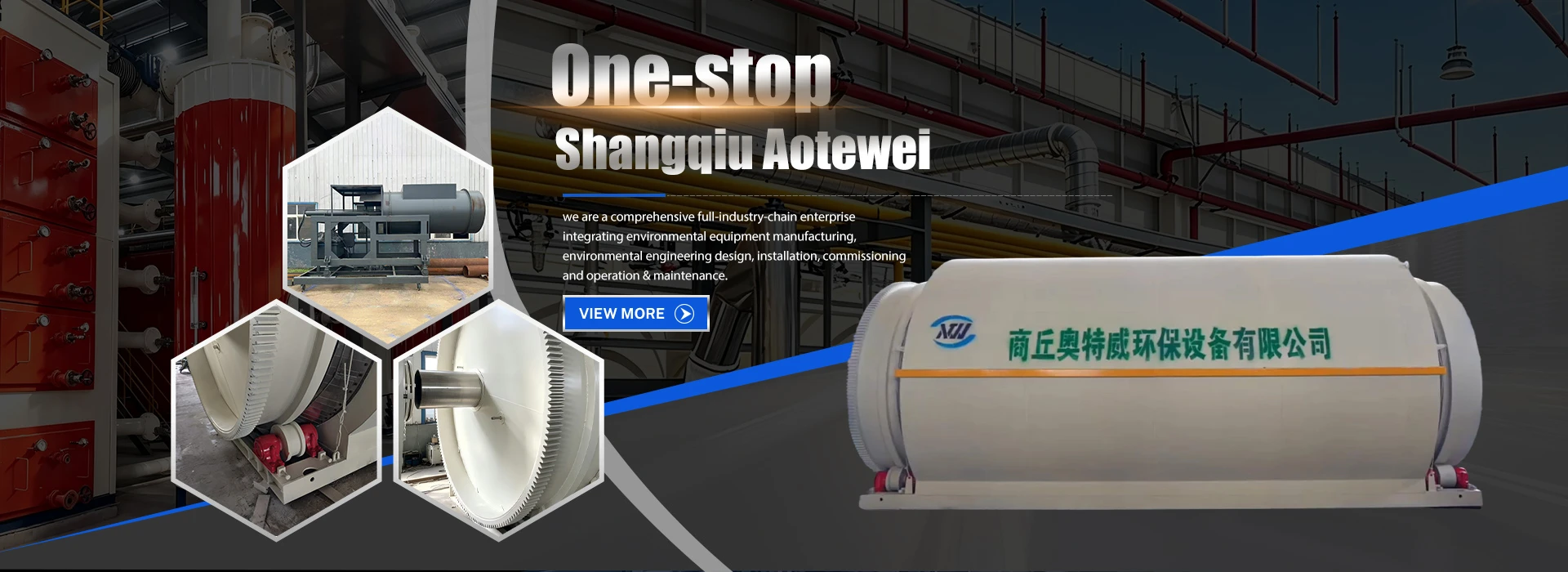
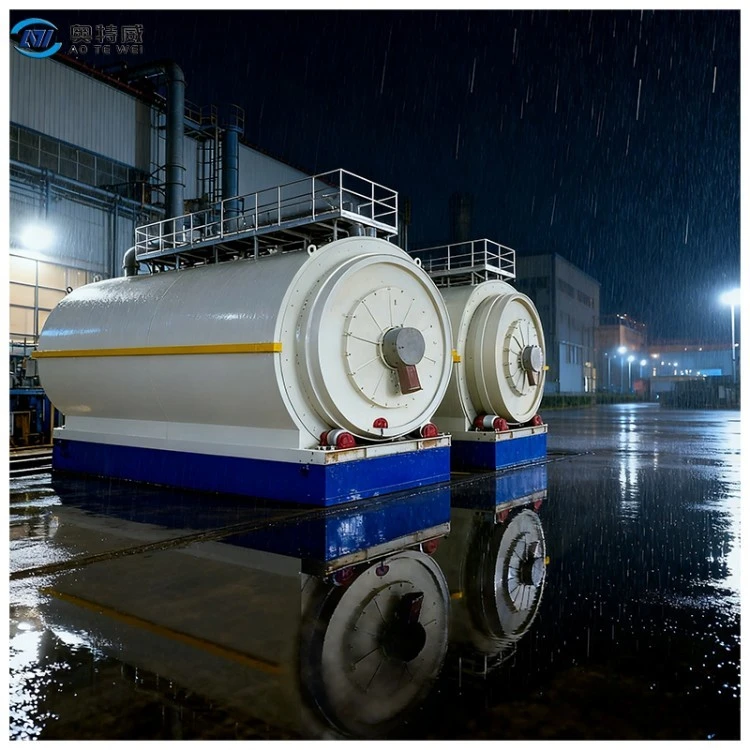
Shangqiu Aotewei Environmental Protection Equipment Co., Ltd. is one of the leading manufacturers and suppliers of high-ash oil sludge pyrolysis plant in China. We are committed to providing high quality customized products with competitive price. If you're going to buy ISO certified high-ash oil sludge pyrolysis plant, welcome to get quotation from our factory.
Our High-Ash Oil Sludge Pyrolysis Plant is a continuous thermal processing system designed for oily sludge with high ash content, high moisture, high viscosity, and a tendency to cause scaling or blockage. With a published reference processing capacity of 30–40 tons per day, the system integrates jacket-heated screw feeding, multi-stage sealing, sectional indirect heating, dehydration, pyrolysis, residue calcination, multi-stage oil condensation, combustible gas recycling, and sealed residue discharge.
Designed for conditioned and pre-treated oilfield sludge, tank bottom sludge, and refinery sludge, this continuous oil sludge pyrolysis plant combines material feeding, thermal processing, oil recovery, and residue handling in one integrated production line.
High-Ash Oil Sludge Processing Capability
The plant is designed for processing the following oily sludge materials:
- Oilfield sludge
- Tank bottom sludge
- Refinery sludge
Its processing configuration addresses the handling requirements of several challenging feed characteristics:
- High ash content: Structural improvements address sludge with high inorganic solid content and a tendency to cause internal deposits.
- High moisture content: An initial dehydration section removes moisture before the main pyrolysis stage.
- High viscosity: A jacket-heated screw feeding system supports the transfer of viscous oily sludge.
- Scaling and blockage: The feeding and thermal processing systems incorporate structural arrangements for challenging sludge handling conditions.
Feed materials should be conditioned and pre-treated before entering the processing line. Large stones and foreign objects should be removed, while high-moisture sludge may require preliminary dewatering. Actual feed suitability and processing capacity depend on ash content, moisture content, oil content, viscosity, and solid composition.
Processing Capacity and Technical Specifications
The published reference processing capacity is 30–40 tons per day, with continuous feeding, thermal processing, and solid residue discharge.
| Technical parameter | Published specification |
|---|---|
| Reference processing capacity | 30–40 tons/day |
| Other listed capacity options | 10–20, 20–30, 40–50 TPD and 100 TPD |
| Processing mode | Continuous |
| Published operating schedule | 24-hour continuous operation |
| Pyrolysis temperature ranges | 450–500°C and 500–540°C |
| Published residence time ranges | 40–60 min and 60–80 min |
| Heating method | Sectional indirect heating |
| Control system | DCS intelligent monitoring |
| Warranty | 1 year |
The additional capacity options are listed in the product specifications. Their equipment configurations and availability require confirmation for individual projects.
The published temperature and residence-time ranges are retained as specified. Their allocation to individual processing sections should be confirmed according to the selected equipment configuration.
High-Ash Sludge Feeding and Pyrolysis System
The processing line integrates feeding, dehydration, thermal decomposition, oil recovery, and residue discharge through three main thermal processing sections.
Jacket-Heated Screw Feeding
A jacket-heated screw feeder transfers conditioned oily sludge into the processing system. Multi-stage sealing and gas-lock arrangements are incorporated into the feeding structure.
This configuration is designed for viscous sludge materials requiring controlled feeding into a continuous thermal processing line. Feed conditioning and removal of large foreign objects are part of the required upstream preparation.
Three-Section Thermal Processing
The main thermal processing system incorporates three functional sections:
- Dehydration section: Removes moisture from incoming sludge before the main pyrolysis process.
- Pyrolysis and oil recovery section: Uses sectional indirect heating to decompose organic components and generate oil-bearing gas.
- Residue calcination section: Provides further thermal treatment of the remaining solid material.
Each processing section has independent temperature control. The published operating temperature ranges are 450–500°C and 500–540°C.
Sealed Residue Discharge
The residue discharge system uses sealed negative-pressure operation and indirect water cooling. Solid residues are cooled before discharge, providing an integrated arrangement for handling hot material at the end of the processing line.
Oil Recovery, Gas Utilization and Residue Handling
The plant incorporates an integrated system for separating and handling the products generated during pyrolysis.
| Output | Processing arrangement |
|---|---|
| Pyrolysis oil | Multi-stage condensation and separation |
| Combustible gas | Recycled to the furnace as a primary heat source |
| Solid residue | Further calcination, indirect water cooling, and sealed discharge |
| Combustion exhaust gas | Routed through the configured exhaust gas treatment system |
The multi-stage condensation system recovers liquid oil from the generated oil-bearing gas. Combustible gas is returned to the furnace for thermal energy reuse.
Final oil yield, recovered oil properties, residue oil content, and energy consumption depend on actual feed composition and operating conditions. These values require project-specific material analysis or testing rather than a universal performance guarantee.
Solid residue disposal or reuse must comply with applicable local requirements and verified residue quality.
Automated Operation and Process Monitoring
The plant uses a DCS control system to monitor key operating parameters throughout the processing line.
| Monitoring or control item | Published configuration |
|---|---|
| Feeding system | Feeding torque monitoring |
| Thermal processing | Temperature monitoring for individual sections |
| Reactor operation | Furnace pressure monitoring |
| Oil and gas recovery | Oil-gas output flow monitoring |
| Protection functions | Torque overload, overtemperature, and overpressure interlocks |
| Operating mode | Centralized DCS monitoring and field operation |
The published staffing reference is 2–3 operators per shift under centralized DCS control. Additional personnel are required for sludge conditioning and pretreatment operations.
The control system supports process monitoring and protective shutdown functions, while operators remain responsible for field inspection and production supervision.
China-Based Oil Sludge Pyrolysis Plant Manufacturing and Project Support
As an oil sludge pyrolysis plant manufacturer in China, we provide equipment manufacturing and project support covering the main production and implementation stages.
Our manufacturing operations include material cutting, welding, machining, equipment assembly, and complete equipment trial operation.
Quality control capabilities include:
- Automatic submerged arc welding for pressure-bearing main reactor fabrication.
- Ultrasonic nondestructive testing of weld seams.
- Water-pressure and air-pressure testing for pressure vessels, condensers, and gas storage tanks.
- Equipment assembly and trial operation before delivery.
Our technical team includes 2 senior technicians, 4 engineers, and more than 20 professional technical personnel.
Project support includes raw material analysis, processing capacity selection, process design, equipment layout planning, installation guidance, commissioning support, operator training, and remote technical assistance. These services allow the equipment configuration to be matched to project-specific feed conditions and processing requirements.
For international projects, available commercial terms include EXW, FOB, and CIF. Technical documentation can include packing lists, equipment dimensions and weight schedules, general layout drawings, civil construction drawings, and process flow diagrams.
Request a High-Ash Oil Sludge Pyrolysis Plant Quotation
Send us your available oil sludge specifications and project requirements to receive an equipment configuration proposal.
You can start with your existing material analysis report, sludge sample photographs, or estimated daily processing quantity. Useful information includes sludge source, ash content, moisture content, oil content, required daily capacity, and project location.
Contact us with your available material information to discuss the processing configuration and quotation for your High-Ash Oil Sludge Pyrolysis Plant.
Hot Tags: high-ash oil sludge pyrolysis plant, China high-ash oil sludge pyrolysis plant manufacturers, suppliers, factory


